[September 9, 2025]
History
After World War II, the automobile dominated our nation’s planning and streetscapes. Suburbs began sprouting up, moving families away from dense, urban downtowns. Many of these suburban neighborhoods were marketed to beneficiaries of the GI Bill, and often redlined to limit the types of folks who could live there. Downtown streets originally designed as two-way thoroughfares were converted to one-way, as the new design was considered a more efficient way to get suburbanites in and out of downtowns quickly. Planner Jeff Speck has written about the conversion of two-way streets to one-way streets in cities across the nation, documenting the damage these changes did to retail businesses and neighborhoods, as they became corridors to get through rather than to inhabit. When it comes to designing city streets as though they are highways, Mr. Speck has written: “‘This mistaking of city streets for highways has probably killed more Americans than any other form of professional negligence.”
During and following the development of the City’s 1998 Comprehensive Plan, more neighborhoods requested traffic calming initiatives. In 2000, the City began studying the feasibility of converting downtown streets back to two-way. Those identified from that study as candidates included: Spring Street, Cannon Street, Coming Street, Ashley Avenue and Rutledge Avenue. Some sections of Rutledge and Ashley were converted to two-way following that study.
Many Charlestonians might remember in 2017, when the City finally converted Spring and Cannon Streets back to two-way. Converting Spring and Cannon was suggested in the City’s 1998 Comprehensive Plan at the request of the Cannonborough-Elliotborough neighborhood, with support from Radcliffeborough and the West Side neighborhoods. Cannonborough-Elliotborough wanted to return Cannon and Spring to two-way in order to slow motorists down to a more humane speed, and help support local businesses.
In 2012, the City further examined converting Coming Street, from Beaufain to Race, back to two-way. Other street segments were recommended for two-waying out of this process: the segment of Coming from Line to Beaufain, the segment of Line Street from Rutledge to King, the segment of St. Philip Street from Coming to Beaufain. Only Line Street was converted following that study. City Council never designated the funding required to move forward with the conversion of the other segments.
Current Project and Situation
By 2024, with neighborhoods continuing to request a Coming Street conversion, the City felt the data from the 2012 analysis had expired. City Council voted to hire a consultant to review the feasibility of two-waying Coming Street (from Calhoun Street to Race Street) and Rutledge Avenue and Ashley Avenue from Calhoun Street to Septima P. Clark Parkway. The consultant is tasked with considering: the challenges of Coming Street’s current one-way operations as identified in the 2012 study; additional neighborhood requests for traffic calming on Ashley and Rutledge; the amount of time that has passed since the 2012 analysis; current traffic volumes and speed; parking and transit; vehicle, pedestrian and bicycle safety and accessibility; impacts on local businesses, hospitals, schools and residential areas; cost for implementation. The consultant began working in 2025.
In early September 2025, the consultant and City hosted a public meeting to present the current traffic volumes and speeds. This is just the beginning of the assessment of whether it makes sense to convert segments of Rutledge, Ashley and Coming back to two-way streets, or if there are other options to improve these corridors for the benefit of all users.
This study is an opportunity not just for you to engage, but also to talk through opportunities for proper bicycle infrastructure (ahem…the People Pedal CHS Plan…). Right now, relying on fast-moving motorists on one-way corridors to safely go around us on bikes is not the best option. Let’s work with the City to determine where there is room for proper bicycle infrastructure, such as bike lanes and cycle tracks, and where it makes sense to two-way traffic, narrow lanes, install curb extensions, raise crosswalks, and improve crosswalks and bus stops. The current status quo is extraordinarily problematic, with many collisions and close calls. If you have been participating in the City of Charleston’s Safety Action Plan process, you may recall that Rutledge Avenue in particular has high rates of bike/ped collisions. We receive many complaints from people on bicycles and foot about the intersection of Rutledge and Fishburne Street. We also participated in SCDOT’s Road Safety Audits of Calhoun Street and Septima P. Clark Parkway; the intersections of Rutledge and the Parkway, as well as Coming and the Parkway, are fatal. The sheer volume of bike/ped users we have counted at Coming and Calhoun is staggering.
People drive too fast, and that behavior is dangerous and deadly in a dense downtown area.
What are the potential benefits of two-waying a street?
In other cities and towns that have reverted their one-way streets back to two, they have tracked the following:
- reduction of pedestrian crashes (often because of reduced turning movements that generate conflict, reduced conflict sequences a pedestrian must look for, and better pedestrian visibility)
- reduction of motor vehicle crashes
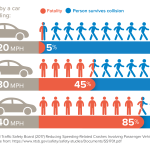
- reduction of speed (and therefore fatalities)
- improved interaction between motor vehicles, bicycles and pedestrians
- better facilitation of what becomes a street grid/network, particularly in emergencies or when obstacles are present
- less confusing transit routes
- fewer vehicle miles traveled since drivers often must double back to their destination if traveling a one-way street
- more successful businesses and fewer vacant buildings
When we shared the City’s first public input opportunity recently, some folks commented they feel safer crossing a street that is one-way because they only have to look one way. Kittelson & Associates analyzed this assumption for one of their “myth buster” write ups. After doing the math, they point out the legal crossing of a two-way street involves “two possible sequences of vehicle conflicts you will encounter.” However, to cross a one-way street, “there are now 16 different permutations of the way these conflicts happen — and pedestrians might not know where to look or what to expect.” There is also the issue of motorists in the far lane of a one-way street who don’t stop at the stop bar, or at all. A person on a bike or on foot who is crossing may not be visible if there are cars in both lanes, and with a negligent driver in the far lane, the onus is on the vulnerable road user to watch out. (Fingers crossed the new SC Hands Free Law cracks down on some of that.)
Because of the widespread and demonstrated benefits of converting a street to two-way, Charleston Moves generally supports the concept of two-waying streets. But it is vital to conduct the data assessment to develop the best plan forward. It’s possible that a simple two-way conversion is not the best solution for Coming, Ashley or Rutledge. But, let’s make sure we participate in the process and get it right. And let’s be clear: leaving the streets as they are currently designed is unacceptable. The most important design goal is to slow people down.
Resources we reference/rely on in this blog
- Bloomberg: One-Way Streets Are the Wrong Way to Tame Downtown Traffic — https://www.bloomberg.com/news/features/2025-09-04/to-tame-traffic-and-boost-safety-cities-rethink-one-way-streets
- City of Charleston: Feasibility Study for Two-Way Traffic of Coming, Rutledge, Ashley project page — https://www.charleston-sc.gov/3132/NEW-Feasibility-Study-for-Two-Way-Traffi
- City of Charleston: Spring and Cannon Corridor Plan project page — https://www.charleston-sc.gov/897/Spring-Cannon-Corridor-Plan
- City of Charleston and Charleston Moves: People Pedal Plan — https://designdivision.squarespace.com/peoplepedal
- City of Charleston Design Division Line Street Two-Way project page — https://designdivision.squarespace.com/line-street
- City of Charleston Design Division Line Street Two-Way project report — https://static1.squarespace.com/static/53e91137e4b0a2440413eae2/t/5c5222d8bba2230f6158a3b8/1548886749547/Report09_LineStreet_01.28.19_Web.pdf
- City of Charleston Safety Action Plan — https://www.charleston-sc.gov/3034/Safe-Streets-and-Roads-for-All-SS4A-Gran
- Congress for New Urbanism: Cities benefit from restoring two-way traffic — https://www.cnu.org/publicsquare/2019/07/09/cities-benefit-one-way-two-way-conversions
- Kittelson & Associates: Myth Busters — Are One-Way Streets Better Than Two-Way Streets? — https://www.kittelson.com/ideas/myth-busters-are-one-way-streets-better-than-two-way-streets/
- Rice University Kinder Institute for Urban Research: Jeff Speck, Author of ‘Walkable City,’ Shares His Urban Rules — https://kinder.rice.edu/urbanedge/jeff-speck-author-walkable-city-shares-his-urban-rules
- South Carolina Department of Public Safety: Hands Free SC Law — https://scdps.sc.gov/handsfree
- South Carolina Department of Transportation: Road Safety Audits (documents on Charleston Moves’ project page) — https://charlestonmoves.org/downtown-bike-plan/
- Streetsblog USA: Jeff Speck — For a Walkable City, Remove Centerlines on Local Streets — https://usa.streetsblog.org/2018/10/15/jeff-speck-for-a-walkable-city-remove-centerlines-on-local-streets