Charleston County Transportation Sales Tax
THE LATEST
The Transportation Sales Tax referendum questions will officially appear on Charleston County ballots for the November 2026 election. Those questions include much of the transparency and specificity for which Charleston Moves has advocated over the past year.
Early Voting Information for the Statewide General Election taking place in Charleston County: October 19, 2026 – October 31, 2026 (CLOSED October 25), 8:30 am – 6 pm.
- County Voter Registration and Elections Office (4340 Corporate Rd, 29405)
- James Island Baxter-Patrick Library (1858 S. Grimball Rd, 29412)
- Morris Brown AME Church (13 Morris St, 29403)
- Greater Macedonia AME Church (725 Savage Rd, 29414)
- Seacoast Church (750 Long Point Rd, 29464)
- St. John’s Episcopal Church (3673 Maybank Hwy, 29455)
- St. Paul’s Hollywood Library (5130 Highway 165, 29449)
Election Day is November 3, 2026. Polls are open from 7 am – 7 pm. Vote at your polling place which can be found at scvotes.gov
DESCRIPTION
Helpful links:
- Charleston County’s Transportation Sales Tax Dashboard HERE (tracks all TST expenditures so far from the 2004 and 2016 Transportation Sales Taxes; feel free to reach out to us at info@charlestonmoves.org if you need assistance with navigation)
- Charleston County’s TST 2026 website HERE (you can find the ballot language, proposed project list, FAQs, and more)
Charleston County has placed two Transportation Sales Tax referendum questions on this November’s ballot. The first question asks Charleston County residents whether they approve extending the ½ cent county sales tax for not more than 25 years or until a total of $4.25B is collected, whichever occurs first. This question is being asked of voters because the 2004 Transportation Sales Tax expires in 2027.
The second question asks Charleston County residents whether they approve the issuance of up to $300M in general obligation bonds, payable from the county sales tax described in the first question. This question is being asked of voters because it can help more quickly fund the completion of projects proposed in the 2026 sales tax. Charleston County is allowed to issue bonds without the public’s vote, but the public’s support of bond issuance lowers the interest rates the County could get on those bonds.
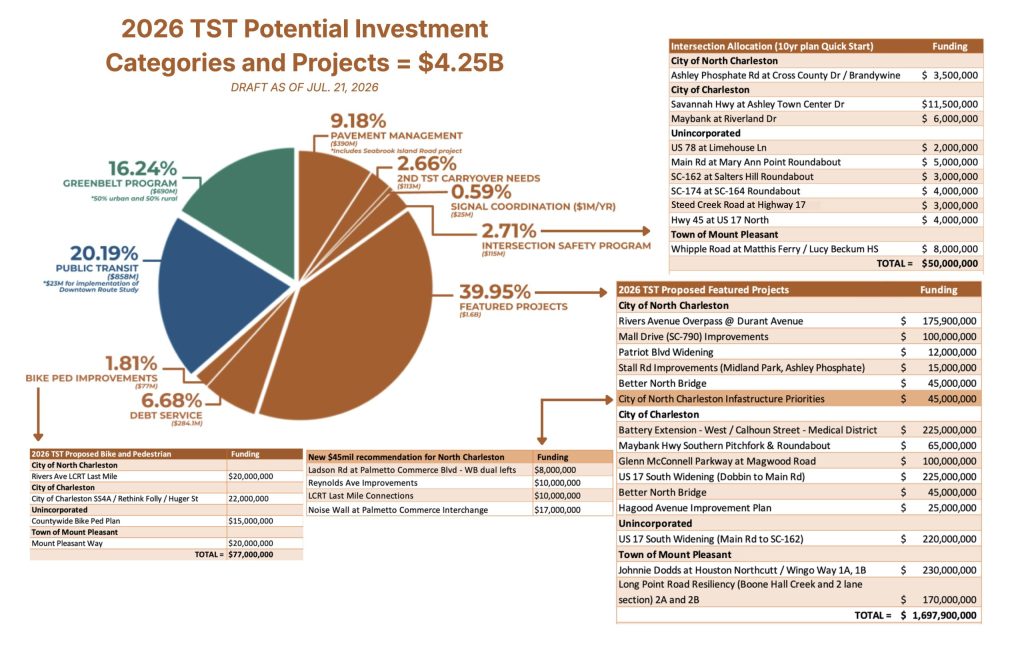
So what is actually in the final 2026 Transportation Sales Tax proposal? The proposal is guided by two documents: the ballot language and then the much more detailed ordinance language. How the County would use the sales tax funding is divided into three categories: Infrastructure, Transit Systems, Greenbelt (land conservation). The pie chart is HERE. Here’s a breakdown of those three categories as listed in the ordinance:
- “Infrastructure” is defined as “highways, roads, streets, bridges, and other transportation-related projects facilities, and drainage facilities related thereto.” This category is further subdivided into Featured Projects, Intersection Projects, Pavement Management, Bike/Pedestrian Improvements, Other Projects. All of these projects shall consider the inclusion of bicycle, pedestrian, and public transit access in the design process, as contextually appropriate. If Charleston County Council determines any project listed is not viable, the Sales and Use Tax revenues associated will be applied to any other project listed below.
- Featured Projects (map here)
- North Charleston area: Rivers Avenue Railroad Overpass at Durant Avenue; Mall Drive Improvements; Patriot Boulevard Widening; Better North Bridge Pedestrian and Bicycle Improvements
- Peninsula: Battery Extension West/Calhoun Street – Medical District; Hagood Avenue Improvements
- West Ashley area: Glenn McConnell Parkway at Magwood Road; US17 South Widening from Dobbin Road to SC-162
- Johns Island: Maybank Highway Southern Pitchfork and Roundabouts
- Mount Pleasant: Johnnie Dodds Boulevard at Houston Northcutt Boulevard and Wingo Way Improvements; Long Point Road Resiliency and Safety Improvements
- Intersection Projects (map here)
- North Charleston area: Stall Road at Midland Park Road and Ashley Phosphate Road; Ladson Road at Palmetto Commerce Parkway; Ashley Phosphate Road at Cross County Road and Brandywine Road; US 78 at Limehouse Lane
- West Ashley area: Savannah Highway at Ashley Town Center Drive
- Beyond West Ashley area: SC-162 at Salters Hill Roundabout; SC-174 at SC-164 Roundabout
- Johns Island: Main Road at Mary Ann Point Roundabout
- Mount Pleasant area: Steed Creek Road at US 17 North; SC-45 at US 17 North; Whipple Road at Mathis Ferry Road and Lucy Beckham High School
- James Island: Maybank Highway at Riverland Drive
- Pavement Management: Resurfacing paved roads throughout Charleston County based on condition, traffic volume, safety requirements, and age of infrastructure, Rural Road Safety Program, Roadway Elevation Resiliency Program including Seabrook Island Road Project.
- Bike/Pedestrian Improvements: Bike and Pedestrian infrastructure throughout Charleston County, including but not limited to:
- Countywide Bike Ped Plan
- Rivers Avenue Lowcountry Rapid Transit Last Mile Connections
- City of Charleston Safe Streets for All Plan, Rethink Folly Road Plan, Huger Street Improvements
- Mount Pleasant Way Plan
- Other Projects: 2016 Sales and Use Tax Carryover Projects (Dorchester Road Widening and Palmetto Commerce Parkway Phase 3), Traffic Signal Synchronization, Reynolds Avenue Improvements, Noise Wall at Palmetto Commerce Interchange Project, and other future needs for highways, roads, streets, bridges, and drainage facilities.
- Featured Projects (map here)
- Transit: For financing the operation and expansion of public transit systems operated by Charleston Area Regional Transportation Authority (CARTA) or jointly operated by the County and other governmental entities and the implementation of the Downtown Route Study.
- Greenbelt: For financing the costs of greenbelts with a 50% urban and 50% rural allocation of the revenues, including but not limited to, purchasing land for conservation, conservation easements, passive greenspaces, public parks, access points to waterways; and protecting natural resources, agricultural landscapes, heritage landscapes, scenic corridors and water resources.
Why is the list so detailed? Because this time around, Charleston County developed a referendum proposal that is specific, allowing constituents to see what they are voting for or against.
An additional note about transit: while not listed explicitly in the ordinance or on the ballot, Charleston County has put together some educational materials regarding the 2026 program. In this slide deck, they suggest the following be included in the transit expenditures:
- Grow service by 17% over the next 10 years, including replacing and expanding the CARTA bus fleet
- Make improvements to major transit corridors, include implementing transit signal priority, building new park & rides, expanding Lowcountry Rapid Transit, and exploring ferry service
- Modernize CARTA’s maintenance facility
- Support Capital Projects by leveraging TST funds for federal grant applications
- Invest in bus stop amenity improvements
That same slide deck includes other helpful information regarding the sales tax as a whole.
What happens if voters approve the TST extension this year? The 2026 half-cent tax would be imposed on May 1, 2030 or the date after which the SC Department of Revenue determines all revenues from the 2004 tax have been collected, whichever comes first. The 2004 half-cent tax is projected to expire in 2027, while the 2016 half-cent tax continues to be collected. Charleston County staff asserts they would immediately begin work on signals, paving, rural road safety, resilience, bicycle and pedestrian facilities, and intersection improvements. They would begin preliminary engineering and design for the largest projects in Year 1, jump-starting work that traditionally would not begin until later in the program. They have a goal to complete improvements to key intersections across the County within the first 10 years by launching the design work immediately. Bonding would accelerate projects.
What happens if voters reject the TST extension this year? The 2004 half-cent tax is projected to expire in 2027, while the 2016 half-cent tax continues to be collected. Charleston County could choose to try for another referendum in 2028 (that would be a new sales tax, not an extension, since 2004 expires in 2027). Local governments could consider increasing property taxes to cover the funding shortfall. Another option would be to simply let the 2016 sales tax run out. That would leave transportation funding to the state and federal agencies, the state-level gas tax collections that are divided to the counties, and perhaps any municipality that decides to budget for transportation improvements.
HISTORY
Charleston County has collected a transportation sales tax (TST) since 2004. That funding has traditionally been split among greenbelt projects and transportation projects, including bicycle, pedestrian, and transit projects. It is one of the primary sources of local dollars for these projects. The County has various mechanisms in place for how to prioritize what projects get funded. They often list specific projects in advance. They also have their annual allocation project matrices, and the Greenbelt Program has its own assessment criteria. You can find more details on the history of the TST:
South Carolina Department of Revenue (SCDOR) TST Audit Findings
Charleston County’s new TST website
Charleston County’s new TST dashboard
Charleston County Transportation Development
Charleston County Greenbelt Program
Previously, $1M has been allocated annually for bike/ped projects through the TST. The municipalities all compete for this funding. Part of the assessment matrix includes public support, which is why we reach out to the public to sign petitions and write support letters for specific bike/ped projects applied for on an annual basis.
Through the Greenbelt Program, the County has designated a connectivity goal. So far, the only applicant for projects addressing this goal has been the Town of Mount Pleasant as they apply for easement funding for segments of Mount Pleasant Way. Greenbelt funds cannot be used to pave bike/ped trails.
We also achieve bike/ped infrastructure as part of roads projects in the TST. One recent example is the multi-use path installed as part of the Glenn McConnell Parkway widening project, and the pending multi-use path for the Limehouse Bridge (Main Road Segment A project).
Public transit is partially funded through the TST. A notable example: approximately half of the funding for the Lowcountry Rapid Transit project is coming from the TST. We also achieve bus infrastructure, like covered bus stops, in certain road projects.
The TST is different from the County’s gas tax allocation (administered through the Charleston Transportation Committee [CTC], and also known as “C” funds).
Charleston County proposed a Transportation Sales Tax referendum in 2024. Constituents overwhelmingly voted against it. For the 2026 proposal, the County emphasized public engagement, data analysis, and transparency. They formed a Special TST Committee of Council, hosted public meetings, and engaged the municipalities across the county.
Charleston Moves, East Coast Greenway Alliance, and Charleston Climate Coalition developed a story map (here), which walks viewers through our guiding principles, research, network maps, and suggested edits to the draft TST, as it was being crafted. We also co-hosted an input session; you can find the recording and transcript here, thanks to North Central Neighborhood Association.
We believe a quality 2026 TST proposal — leveraged with federal, state, and other funding sources — can get us the Charleston County that we all want to live and thrive in. One where we move and recreate how we choose, with equitable access and safe, healthy residents. But, it has to be balanced, thoughtful, and provide a true benefit to all community members!
We cannot overstate the importance of a robust bike/ped improvements program; safe and connected bicycle and pedestrian infrastructure is an urgent, widespread need. According to a 2026 report by Smart Growth America, Charleston-North Charleston is the twelfth most deadly metro region for pedestrians in the nation, with South Carolina ranking third most deadly state in the nation. Charleston County tops the state. If there is not strong investment in the bike/ped category, and in complete streets, more and more residents will be killed. This potential $4.25 billion offers a real chance to do something about it.
- Charleston Moves and partners’ original white paper covering our priority principles for development of a 2026 TST referendum HERE and associated draft Story Map HERE
In January 2026, County Council’s special TST committee received a presentation from their consultants that summarized public input. Some high points:
- Survey produced nearly 29k comments from 2,486 respondents
- Separate public opinion poll was conducted to 693 respondents
- Themes: congestion, growth, cautious support of a TST extension to directly address congestion and growth if visible results are delivered. Safety also identified as a top issue, with bike/ped improvements identified as urgent and not just “nice to have.”
- 634 specific project location requests were submitted, at an estimated total cost of $68B
- 230 specific road projects, 200 bike/ped projects, 90 transit projects, and 100 greenbelt projects were suggested
The team suggested some guiding principles to govern the development of a potential TST referendum going forward, based on public input. The public input report can be found here. Survey findings include:
- 53% survey respondents find “Transit service expansion & Lowcountry Rapid Transit (LCRT)” important/very important
- 66% survey respondents find “Bike & pedestrian network (closing gaps, improving safety)” important/very important
- When asked to budget a hypothetical $100, people identified 24% towards bike/ped and 22% to public transit
- Bike/ped improvements ranked slightly more important than intersection improvements as part of road projects